

Every answer traced back to a DBC document.
The AI Brain reads the company's own settlement statements, listings, loan records and budgets, and its weekly foreclosure auction lists, and answers questions about them in plain English. It shows the document behind every figure, and it only ever reaches what your role is allowed to see.
How an answer is made
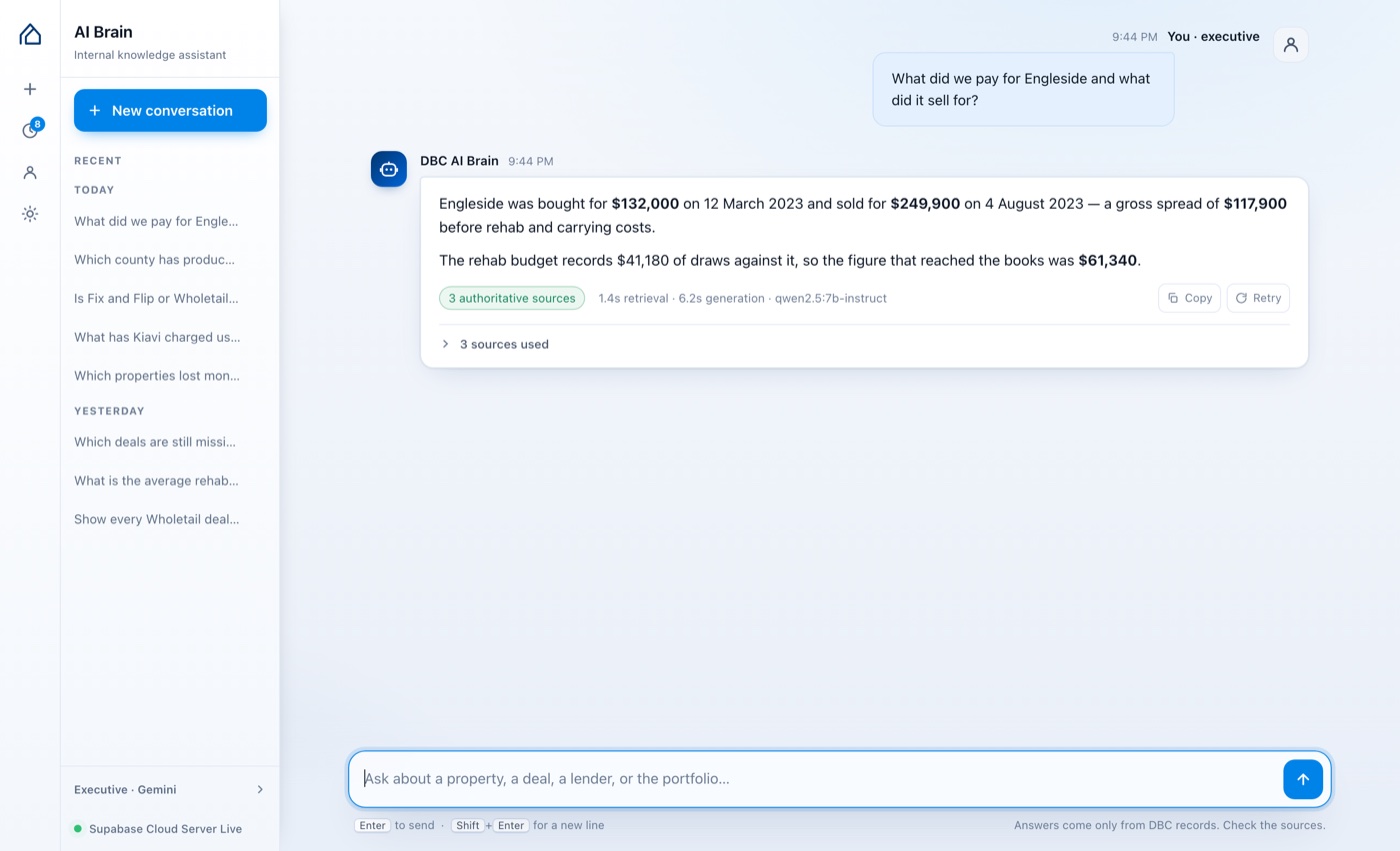
Four steps, in this order. The third is the one that matters: access is applied while the records are being searched, not by trimming an answer afterwards.
You ask in plain English
No field names, no filters, no query language. Ask it the way you would ask a colleague who has read every file in the cabinet.
It searches the records two ways at once
Meaning and wording together, so a question that uses none of the right terms still finds the right passage, and one that names an exact figure finds that too.
full text over the same set
merged, then ranked
Your role is applied before you see anything
The filter goes inside the query, not around it. A passage your role may not read is never retrieved in the first place, so it cannot reach the answer by accident.
The answer cites what it used
Every figure is traceable to the document it came out of, quoted beside the answer. Where the records do not support an answer, it says so rather than filling the gap.
What it has read
Nothing here was bought, scraped or assumed. Every number came out of a file DBC already had, and the file it came from is recorded alongside it.

Settlement statements
Every line of every HUD-1, on both sides of the deal: contract price, credits, payoffs, commissions and the settlement date.
MLS listings
List and close price, days on market, buyer financing, and the property detail behind each one.
Lender records
Draws, payments and payoffs read from 143 statements across DBC's lenders.
Rehab budgets
Budget against actual spend, line by line, so a scope can be compared with what it really cost.
Profit reconciliations
Where a figure reported in a spreadsheet and a figure computed from the documents do not match, the difference is written down rather than quietly resolved.
Foreclosure auction lists
Every trustee's sale on DBC's weekly lists, 2020 to 2026: 542 list files read, 6 auctioneers, 8 counties, with how each sale ended and DBC's own screening, bids and wins behind the role filter.
The company's vocabulary
Glossary terms taken from how DBC actually writes things down, alongside 291 catalogued columns.
A figure you cannot trace is a figure you cannot use. Every number this assistant gives you arrives with the document it was read out of, and the passage it was read from.
Two search indexes, side by side
The same passages are indexed twice: once by a model running on the company's own machine, and once by Google's hosted embedding model. Both are complete. Questions use Google's, and if it is ever unavailable the assistant switches to the local one on its own.
It would rather say nothing than guess
When the records do not answer a question, the assistant says so. It does not round, estimate, or fill a gap from general knowledge, because an invented figure in a business like this one is worse than no figure at all.
Sometimes that answer means the records cannot see it. Sometimes it means your role cannot. The difference matters
Ask it about a house.
Records only earn their keep when somebody can act on them. This is 251 properties and every settlement statement behind them, turned into answers that arrive while the decision is still open: which county to buy in next, which exit to take, which lender is quietly costing the most.
Start with a house you already know the answer for, and check the sources it gives you.